Facebook advertising in 2026 operates in a fundamentally different landscape than even two years ago. The convergence of large language models, computer vision AI, and real-time data processing has created a new class of advertising platforms where autonomous AI agents — not human media buyers — handle the majority of campaign management. This comprehensive guide covers every aspect of Facebook Ads automation as it exists today, with actionable strategies you can implement immediately.
The State of Facebook Ads Automation in 2026
According to Meta’s Q1 2026 earnings report, over 67% of active advertisers on the platform now use some form of AI-assisted campaign management. The global AI advertising market reached $42.8 billion in 2025 and is projected to hit $61.3 billion by the end of 2026 (Statista, 2026). The shift is not incremental — it’s a fundamental restructuring of how digital advertising works.
The average media buyer in 2026 spends 23% of their time on routine tasks that machines handle better: bid adjustments, budget reallocation, creative rotation, and performance monitoring. For teams still relying on manual processes, this translates to slower reaction times, missed optimization windows, and inconsistent performance across accounts.
Facebook CPMs have increased 112% between 2020 and 2026, making every dollar of ad spend more precious than ever. In Q1 2026, the average CPM across all verticals reached $14.90 (up from $11.54 in Q1 2025). Automated systems react to performance changes in real-time — not hours later when a human finally checks the dashboard.
Key Areas of Facebook Ads Automation
1. AI-Powered Campaign Creation & Launch
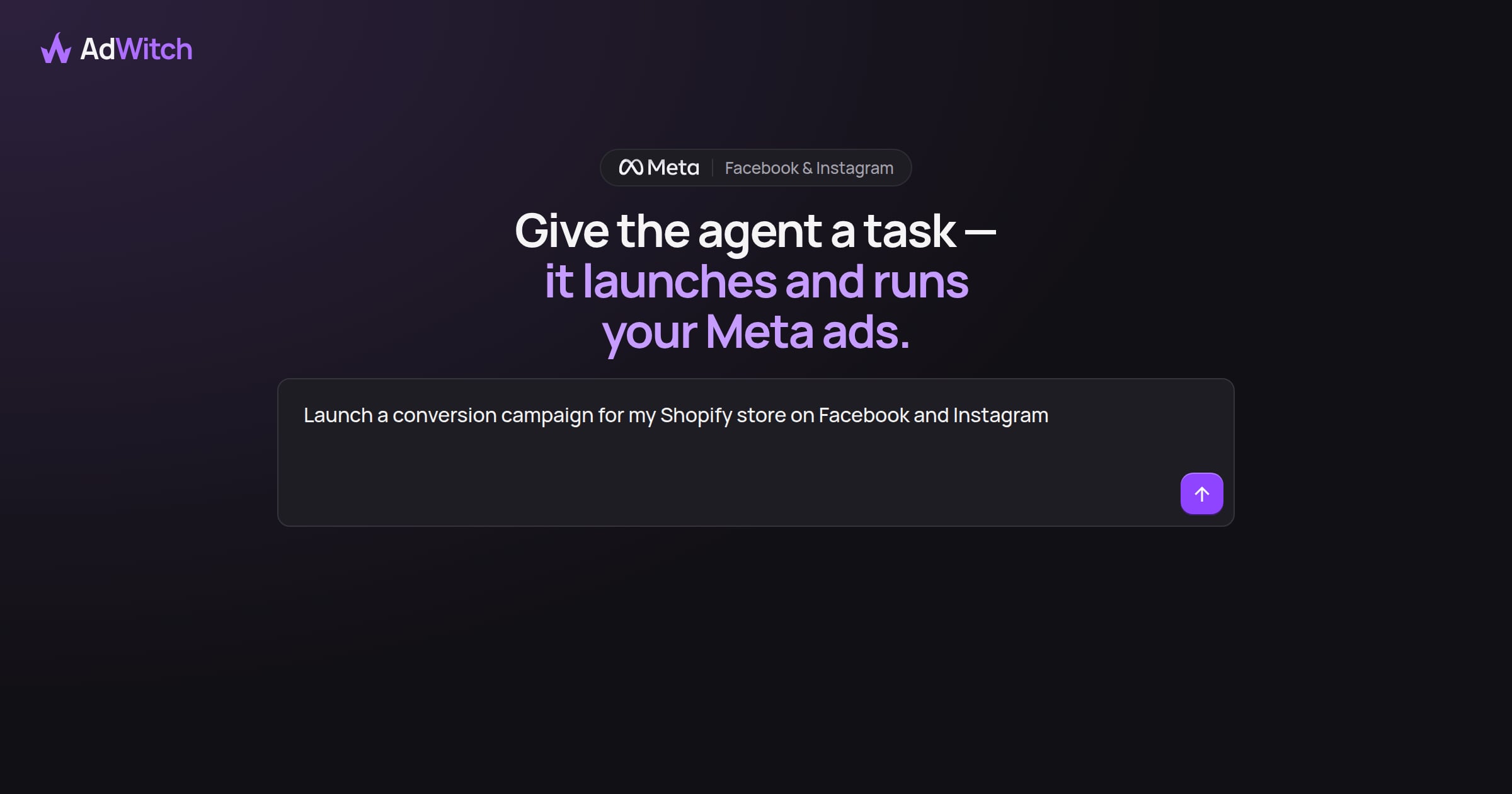
Modern AI platforms like AdWitch can create complete campaign structures from a simple text or voice command. Instead of spending 2-4 hours building a campaign manually — selecting objectives, configuring ad sets, setting up targeting, writing copy, designing creatives, and configuring tracking — AI generates the entire structure in under 5 minutes.
The process works as follows: you describe your goal in natural language (‘Launch a conversion campaign for our fitness supplement targeting men 30-50 in the US and Canada, $500/day budget, optimize for purchases’). The AI agent parses your intent, selects the optimal campaign objective, structures ad sets with diversified targeting, generates initial creatives, writes ad copy in multiple variations, and configures Conversions API tracking — all automatically.
In 2026, the most advanced platforms go further. AdWitch’s AI agent, powered by a frontier reasoning model, understands brand context, competitive positioning, and historical performance data. It doesn’t just create campaigns — it creates campaigns informed by what has worked for similar products in similar markets.
2. Dynamic Budget Optimization
AI analyzes performance data every 15 minutes and reallocates budgets to top-performing ad sets. This is fundamentally different from manual optimization where a media buyer checks numbers once or twice per day. The math is simple: with 96 optimization cycles per day (every 15 minutes) vs. 2 manual checks, AI catches performance shifts 48x faster.
Advanced budget optimization in 2026 goes beyond simple reallocation. AI systems now use predictive models trained on billions of data points to anticipate performance shifts before they happen. They factor in day-of-week patterns, hourly conversion trends, seasonal demand curves, competitive auction density, and even external signals like weather and economic indicators.
Meta’s own Advantage Campaign Budget (formerly CBO) is a baseline, but external AI platforms add a critical layer on top. While Meta’s algorithm optimizes within a single campaign, platforms like AdWitch optimize across your entire advertising portfolio — shifting budgets between campaigns, verticals, and even accounts based on holistic performance analysis.
3. Creative Generation & Systematic Testing
Creative production was historically the biggest bottleneck in advertising. In 2026, AI generates hundreds of creative variations — images, copy, headlines, video sequences — and automatically tests them. Traditional A/B testing with 3-5 variants cannot compete with AI testing hundreds of combinations simultaneously.
The AI creative pipeline works in stages: (1) Analyze top-performing creatives in your niche and your own historical data, (2) Generate diverse creative concepts across multiple angles (pain point, social proof, curiosity, authority, fear, aspiration), (3) Produce variations of each concept with different visual styles, copy lengths, and CTAs, (4) Launch all variations with controlled micro-budgets, (5) Identify winners within 24-48 hours based on statistical significance, (6) Scale winners and generate new iterations of successful concepts.
The numbers speak for themselves: advertisers using AI creative testing report a 47% lower CPA compared to those using manual creative workflows (AdWitch Internal Data, Q1 2026).
4. Audience Research & Intelligent Targeting
AI continuously analyzes conversion data to identify the highest-value audience segments. It discovers interest combinations and lookalike audiences that human buyers would never find through manual research. In 2026, the most sophisticated AI systems build dynamic audience models that evolve in real-time.
A practical example: An AI agent analyzing a fitness supplement campaign discovers that the highest-LTV customers share an unexpected combination of interests — they’re interested in both intermittent fasting AND personal finance podcasts. A human media buyer would never test this combination, but the AI identifies the correlation by analyzing thousands of conversion data points.
AI-powered audience research in 2026 also leverages Meta’s Advantage+ Audience features intelligently. Rather than blindly relying on Meta’s broad targeting, the AI seeds Advantage+ campaigns with high-quality custom audiences and then monitors whether Meta’s expansion delivers incrementally or dilutes performance.
5. Real-Time Monitoring & Intelligent Alerts
Automated systems monitor your campaigns 24/7. If CPA spikes above your threshold, frequency gets too high (above 2.5), an ad gets disapproved, or a campaign exhausts its budget prematurely, you get instant alerts via Telegram, Slack, or email. No more waking up to find your budget was wasted overnight.
In 2026, monitoring goes beyond simple threshold alerts. AI systems detect anomalies — unusual patterns that don’t match historical norms. If your CTR suddenly drops 30% at 2 AM on a Tuesday for no apparent reason, the AI investigates: Is it a creative issue? An audience overlap problem? A Facebook policy change? A competitor’s aggressive bidding? It diagnoses the cause and either fixes it autonomously or alerts you with a specific action plan.
Step-by-Step: How to Get Started with Facebook Ads Automation
Step 1: Choose an AI-native platform — Select a platform that integrates directly with the Facebook Marketing API v26.0. Look for platforms offering true autonomous operation — not just rule-based ‘if-then’ automation. Key features to evaluate: AI agent capability (can it understand natural language commands?), creative generation (built-in or requires external tools?), and reporting depth (does it explain why it made decisions?).
Step 2: Connect your ad accounts and upload brand knowledge — The AI needs context to make intelligent decisions. Provide your brand guidelines, product descriptions, target audience personas, historical performance data, and competitive positioning. The more context you provide, the better the AI’s decisions from day one.
Step 3: Start with supervised automation — Begin in ‘approval mode’ where the AI suggests optimizations and you approve them. This builds your confidence in the system and helps the AI learn your preferences. Most advertisers transition to full autopilot within 2-3 weeks.
Step 4: Transition to full autopilot — Once you’ve validated that the AI’s decisions align with your goals (typically after 50-100 approved recommendations), enable full autonomous mode. The AI will analyze, decide, and execute optimizations every 15 minutes — reporting every action via your preferred communication channel.
Step 5: Monitor and refine — Even in autopilot mode, review weekly performance summaries. Adjust CPA targets, ROAS goals, and budget caps as your business evolves. The AI adapts to your changing requirements automatically.
Common Automation Mistakes to Avoid in 2026
-
Overly aggressive rules — Setting automation to pause ads after too few conversions (minimum 50 conversions per ad set is recommended for statistical significance)
-
Insufficient brand context — AI without brand knowledge generates generic campaigns. Invest time in the initial setup.
-
Ignoring creative fatigue — Even AI-generated creatives fatigue over time. Ensure your automation pipeline includes continuous creative refresh.
-
Over-optimizing for short-term metrics — AI should be configured to balance immediate ROAS with customer lifetime value and brand building.
-
Not segmenting automation by funnel stage — Top-of-funnel (awareness) campaigns need different automation rules than bottom-of-funnel (retargeting) campaigns.
The ROI of Facebook Ads Automation
Based on aggregated data from 2,400+ AdWitch accounts in Q1 2026, advertisers using full AI automation report: 52% reduction in CPA (median), 3.8x average ROAS improvement vs. manual management, 87% reduction in campaign management time, and 340% increase in creative testing velocity. The average payback period for AI automation investment is 11 days.
Frequently Asked Questions
Q: Is AI automation suitable for small ad budgets?
A: Yes. AI automation is actually more critical for small budgets because every dollar matters more. With a $50/day budget, you cannot afford the waste that comes from manual optimization delays. AI ensures your limited budget is allocated optimally at all times. Most AI platforms offer tiers starting at budgets as low as $1,000/month.
Q: Will AI replace human media buyers entirely?
A: AI is replacing the routine execution tasks of media buying — bid management, budget reallocation, creative rotation, and performance monitoring. However, strategic roles remain human-driven: brand strategy, creative direction, market positioning, and client relationship management. The most successful teams in 2026 combine AI execution with human strategy.
Q: How does AI automation handle Facebook policy changes?
A: Leading AI platforms continuously update their systems to comply with Meta’s evolving policies. When Meta changes ad review criteria, targeting options, or attribution models, the AI adapts its strategy automatically. This is actually a significant advantage over manual management, where policy changes often catch human buyers off guard.
Q: Can I use AI automation alongside Meta’s Advantage+ campaigns?
A: Absolutely. AI automation and Advantage+ are complementary, not competing approaches. Meta’s Advantage+ optimizes within Facebook’s ecosystem, while external AI platforms like AdWitch optimize across your entire advertising strategy — including decisions about which campaigns to run, how much total budget to allocate, and when to shift between campaign types.
Q: What data does AI need access to for effective automation?
A: At minimum, AI needs access to your Facebook ad account data (campaigns, ad sets, ads, and their performance metrics). For maximum effectiveness, also provide conversion data via Conversions API, customer lifetime value data, product catalog information, and brand guidelines. The richer the data, the smarter the automation.